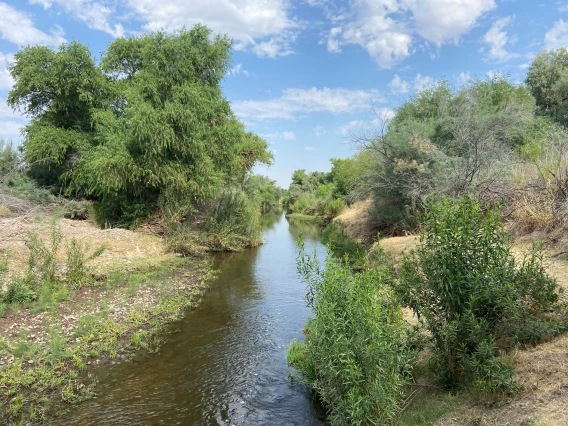
Students will investigate how environmental conditions along the Santa Cruz River influence the survival of native willow seedlings. Through a simulation, students model variation within a willow population and examine how traits such as root growth affect survival under changing environmental conditions. Students then develop a scientific model explaining how natural selection changes the frequency of a trait in a population over time. Students can compare scenarios before and after river restoration to consider how changing environmental conditions alter which traits are advantageous.
- Objectives
- I can analyze data to identify environmental changes in the Santa Cruz River.
- I can identify variation among individuals within a population.
- I can explain how environmental changes create selection pressures.
- I can develop a scientific model that explains how natural selection changes populations over multiple generations..
- Grades: 6 to 8
- Time: 2 to 3 days + Santa Cruz River field trip
- Author: A Pellman
Arizona Standards Engaged
8.L4U1.11: Develop and use a model to explain how natural selection may lead to increases or decreases of specific traits in populations over time.
- Natural selection leads to the predominance of certain traits in population and the suppression of others.
- Adaptation by natural selection acting over generations is one important process by which species change over time in response to changes in enviornmental conditions. Traits that support successful survival and reproduction in the new environment become more common; those that do not become less common. Thus, the distribution of traits in a population changes.