Biological Research Experiences
for Teachers (BIORETS)
Meet BIORETS Santa Cruz River teachers, graduate mentors, and University of Arizona leads.
BIORETS is an immersive summer research experience for teachers followed by a full year of supported curriculum implementation. Teachers in the greater Tucson metro area, including the Tohono O'odham and Pascua Yaqui Nations, participate. Teachers often describe their experience as “life changing”. BIORETS has been funded by the National Science Foundation from 2022 to 2028.
UA Program Leadership
Michael Bogan overseas the research areas of BIORETS, including providing in-depth education on our regional water cycle, field research methods, as well as data collection and visualization. Michael is an Associate Professor in the School of Natural Resources and the Environment. In his spare time, he is hiking the Sierras, exploring tinajas, and keeping his dog Lola happy with endless ball-chasing in the park.
Jacqueline Bruhn is the BIORETS education specialist and administrative coordinator. She develops classroom curriculum focused on data science skills, place-based science learning, and facilitating school year implementation. Jacqueline is research staff in the School of Natural Resources and the Environment. She is happiest outside, exploring the Sonoran Desert or in her garden collecting seeds, fixing irrigation, and drawing plants.
Rebecca Lipson led the development and implementation of the classroom portion of BIORETS during the first 3 years of the program. Her primary role at UA is focused on undergraduate research initiatives and supporting undergraduate success and retention. When not in front of a computer or in a classroom, Rebecca can be found gardening, hiking, camping, and just generally enjoying the outdoors with her family.
Margaret Wilch supports teachers in building data science skills and transferring their BIORETS experience into their classrooms. Margaret founded and co-leads Teachers in the Wild based at the Southwestern Research Station after teaching at Tucson High for 26 years. Margaret can be found in the Chiricahua Mountains, capturing the world in her sketchbook.
Research Groups and Graduate Mentors
Bird Research

Bird Research Group explores the many ways you can observe and document the incredible diversity of riparian birds along the river, with teachers learning bird identification by sight and sound, the use of technology in bird surveys (e.g. Merlin app), and different ways that their students can document bird ecology at home, on their campuses, and along the Santa Cruz River.
Dragonfly Research

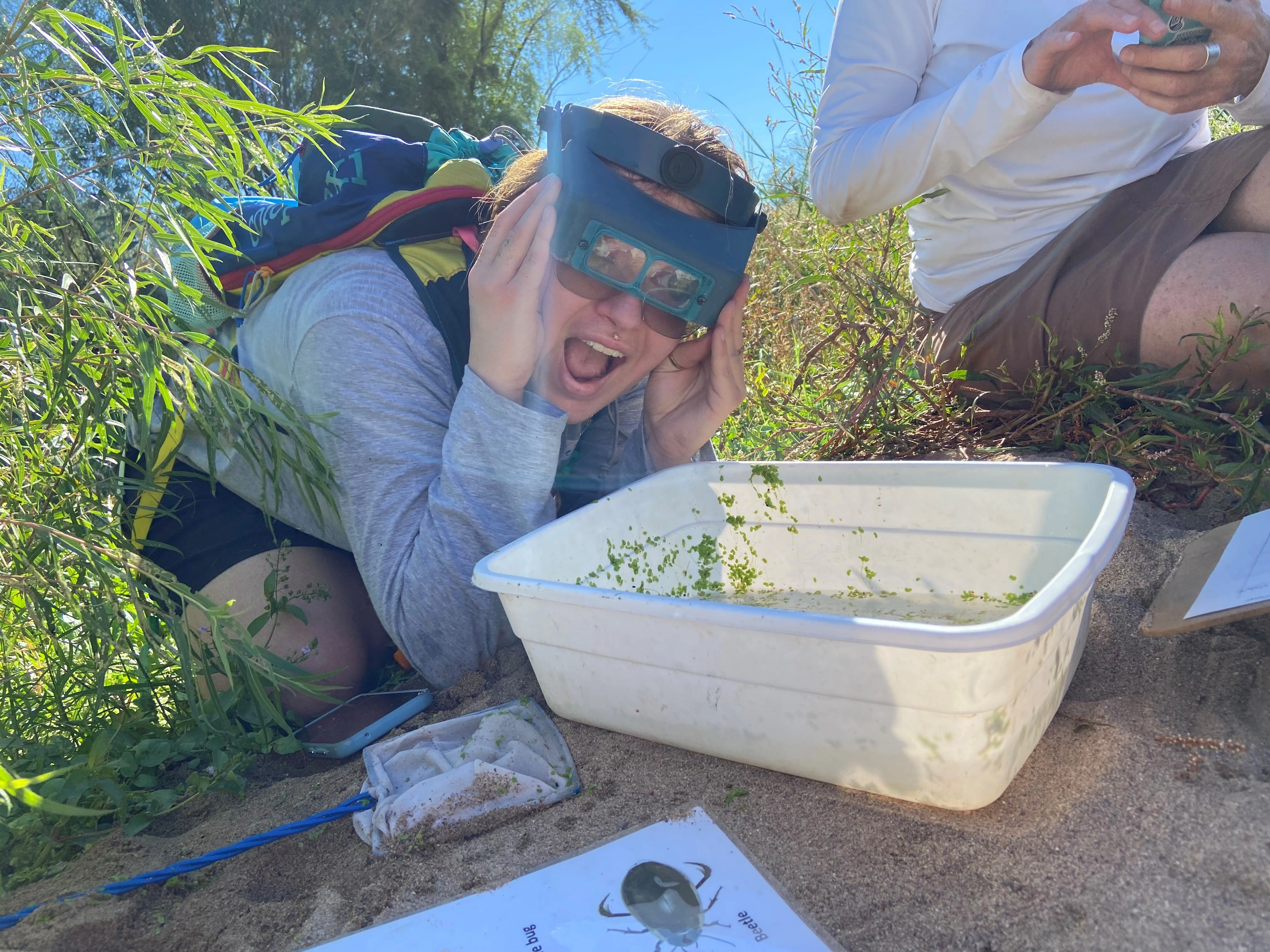
Dragonfly Research Group examines the impressive diversity of colorful dragonflies and damselflies at several locations on the river. Teachers learn how to identify species visually, use nets to see these insects up close, and measure habitat characteristics (e.g. vegetation type, flow volume) that help explain why there are so many species on the river.
Riparian Plant Research

Riparian Plant Research Group identifies the myriad wetland and riparian plants growing along and in the river that provide habitat and food for the local fauna. Teachers learn how to quantify the differences in plant populations across sites with different levels of flow and different flow histories, and also participate in active restoration activities (e.g. plantings) for culturally important riparian plants.
Turtle Research

Turtle Research Group learns how to conduct turtle surveys at 6 six sites along the Santa Cruz River to assess populations of native and non-native turtles, take biometric measurements of each individual turtle to see how healthy they are, and quantify habitat characteristics that may influence turtle distributions (e.g. flow velocity, depth).
Wildlife Camera Research

Wildlife Camera Research Group documents the wide variety of small and large animals that rely on the riverbed for drinking water or their homes by installing and maintaining 10 wildlife cameras along the river in flowing and dry reaches, learning how to identify our diverse mammal fauna, and use image processing programs (e.g. Timelapse) to turn wildlife photos into data.
Graduate Mentors
Allie Burnet (Wildlife, 2022, 2023) received her PhD in Natural Resources - Wildlife Conservation and Management Program. Her research intersects animal behavior, ecology, and conservation, centering on wildlife responses to environmental changes.
Eduardo Gracia (Wildlife, 2025, 2026) is a MS student in the Natural Resources - Wildlife Conservation and Management Program. His research focses on the impacts of human infrastructure and the US/Mexico Border Wall on the mammal communities between El Pinacate Biosphere Preserve and the Organ Pipe Cactus National Monument.
Miguel Grageda Garcia (Turtles, 2022, 2023) received his PhD in Natural Resources - Wildlife Conservation and Management. After graduating, he joined the Arizona Game and Fish Department as an International and Borderlands Wildlife Specialist.
Rocio Guzman (Dragonflies, 2023, 2024, 2025, 2026) is a PhD student in the Natural Resources - Wildlife Conservation and Management Program. Her main interest is understanding how wildlife populations and communities are affected by disturbances in their ecological interactions, especially freshwater invertebrates, such as dragonflies and damselflies.
Conor Varela Handley (Plants, 2022, Turtles, 2024, 2026) is a PhD student in the Natural Resources - Wildlife Conservation and Management Program. His research interests include the conservation of culturally significant species, Indigenous science, desert ecology, herpetology, and entomology.
Deandra Jones (Wildlife, 2026) is a PhD student in the Natural Resources - Wildlife Conservation, and Management Program. Her current research focuses on estimating the black bear population on the Navajo Nation and understanding human–bear interactions, with attention to Navajo cultural relationships.
Margaret Mercer (Wildlife, 2024) received her MS in Natural Resources - Wildlife Conservation and Management. Her research focused on the effects of human presence on North American carnivores, with a goal to support conservation efforts and protect the world's ecosystems.
Pablo Rocha (Birds, 2022) received his MS in Natural Resources - Wildlife Conservation and Management. He is a natural resources biologist that specializes in avian ecology at the community and population levels.
Kat Sacoman (Plants, 2023, 2024, 2025, 2026) recently completed an MS in Natural Resources - Ecology, Management, and Restoration of Rangelands. Her researched focused on riparian plant populations in the Santa Cruz River. Kat is currently the Garden Teacher at Manzo Elementary in Tucson.
2026-2027 Teachers
Representing 12 schools across 6 districts from Nogales to Tucson.
Elementary School Teachers
Alison Knight is a 4th grade teacher at Holaway/Rio Vista in Tucson. She is looking forward to being part of BIORETS to deepen her understanding of environmental science and bring engaging, real-world learning experiences back to her students.
Kimberly Smith is a K-5 STEM and Gifted teacher at Holaway/Rio Vista in Tucson. She is very excited to join BIORETS not only to gain new knowledge of our natural world but to also bring learning opportunities into her classes.
Middle School Teachers
Cinnamon Conrad is a 7th and 8th grade GATE math teacher at Alice Vail Middle School in Tucson. Cinnamon is looking forward to creating relevant math projects that incorporate science to make learning more engaging for her students.
Amanda Pellman is a middle school science teacher at Wakefield Middle School in Tucson, AZ. She hopes to learn how she can use the Santa Cruz River and its local ecology to create authentic learning experiences for her students.
Wendy Peterson is a 7th and 8th grade English Language Arts and electives teacher at Doolen Middle School, in Tucson. Wendy plans to create interdisciplinary, inquiry-driven learning experiences that connect literacy with real-world environmental science in her classroom.
Rey Reyes is a middle school science teacher at Sierra K-8 in Tucson, Arizona. He applied to BIORETS because he wants to bring hydrology and water sciences into his classroom curriculum in whatever way possible.
Rizza Earl Veverly A. Sible is an 8th grade science teacher at Doolen Middle School in Tucson. She is excited about participating in BIORETS because she loves science and wants to improve her research skills, teaching methods, and connection to nature and the Santa Cruz River.
High School Teachers
Victoria Bodanyi teaches Culturally Relevant History and Applied Sustainability at Pueblo High School in Tucson. She hopes to expand her knowledge of sustainability practices in the Sonoran Desert to enhance her curriculum.
Patrick Byrne teaches high school students at Cholla High School in Tucson. He applied to BIORETS because it engaged his curiosity of local science and how to bring it to his classroom to share with his students.
Tim Evans is a high school English teacher at Salpointe Catholic High School in Tucson. He is looking forward to the BIORETS program to learn about and try more experiential learning in his Language Arts classes.
Chris James is an Environmental Science and Anatomy & Physiology teacher at Salpointe Catholic High School in Tucson. Given his love for fieldwork in general and aquatic ecology in particular, there’s no way he wouldn’t apply for a program like BIORETS.
Erik Lehmkuhl is a Biotechnology teacher at Pueblo High School in Tucson. He is excited to incorporate more ecology and nature into his Biotech classroom and bring Pueblo students to the Santa Cruz River.
James Lopez teaches students in grades 9 through 12 at Sahuaro High School, in Tucson. James is looking forward to learning about Santa Cruz River restoration efforts so that he can share local environmental success stories with his students!
Jordan Sene teaches in the Santa Cruz County USD in Rio Rico and at Pima Community College in Nogales. She is looking forward to building knowledge and skills to deepen students' connection to nature, culture, and place as part of BIORETS.
Alexis Trujillo is a high school biology teacher at Sahuaro High School in Tucson. She is doing BIORETS because she loves to be active and learn and sees this as a great opportunity to become a better teacher!
JohnWessley Young is a high school science teacher at Palo Verde High Magnet School in Tucson. His desire to be outdoors and do more hands-on research, pertaining to biology, led him to apply for the BIORETS program.